
UK Punter's Playbook · MLB Props
MLB Prop Bets in the UK: A Punter's Complete Playbook
 Available in US
The first MLB prop I placed from a London flat was a Vladimir Guerrero Jr. home run at +320 on a sticky July evening. I cashed it. I also lost the next eleven HR props in a row — roughly when I learned that one good night tells you nothing about a sport played 162 times a year.
This guide exists because nobody is writing about MLB props for British punters. Open any American site and you'll get daily picks in dollars and American odds, park factors for stadiums you've never visited, start times in Eastern. None of it accounts for a UKGC-licensed bet slip, decimal pricing, or West Coast first pitches landing at three in the morning over here.
Who this guide is for: the UK punter who understands decimal odds and handicaps and wants the same fluency in baseball props. You don't need to know a slider from a cutter yet. By the end you will.
The British gambling market is the largest regulated one in the world — gross gambling yield hit £15.6 billion in the year ending March 2025, with around 48% of adults gambling in any four-week window. Football and racing soak up most of it; US sports are growing fastest. The infrastructure to bet MLB from the UK exists at every major book. The literature to bet it well doesn't.
I'll cover prop categories, decimal pricing on lines that originate in American odds, how UK books handle MLB depth, what park factors and weather do to a price, the 2025 UKGC reset, time-zone tactics, bankroll discipline across 162 games, and where edge hides. By the end you'll have a system, not a tip sheet.
MLB Props for UK Punters: Quick Strategies
- An MLB prop is a wager on a within-game outcome — a player's strikeouts, total bases, hits or home runs — priced separately from the moneyline; UK books price these in decimal but the lines originate in American formats.
- British interest in baseball climbed from 4% to 5.9% of sports fans in four years, MLB Europe's social following tripled past 452,000, and TNT Sports broadcasts 15 regular-season games a year — the sport is no longer fringe in the UK.
- UKGC's 2025 reforms — a statutory levy from 6 April and a £150 vulnerability threshold from 28 February — change how UK books treat your account, not whether you can bet on baseball.
- Hold on player props sits two to three times higher than on moneylines, making line-shopping across UK books and learning park factors the sustainable edges for a recreational punter.
- Five clusters follow: bookmakers, odds maths, prop categories, park factors, regulatory backdrop. Read in any order.
What Prop Bets Actually Are in a Baseball Context
A friend of mine — devoted Arsenal man, decade of in-running football betting under his belt — once asked, in genuine bafflement, why I was watching a single batter walk to the plate with my phone in my hand. "The whole game's nine innings, what are you even waiting for?" I was waiting for Aaron Judge's second hit. The whole game wasn't my bet. One man swinging a bat was.
That's the shift. A prop — short for proposition — is a wager on something that happens inside a game without depending on who wins. You don't need the Yankees to beat the Astros for your bet to land; you need a specific outcome, usually attached to a specific player. The moneyline is the result of the contest. A prop is a small bet on a small thing inside it, and there are dozens per match.
Prop bet — short for proposition bet. A wager on a discrete in-game event, typically tied to a player or team performance, settled independently of the match result. Also called a special or a player special depending on the book.
The reason props matter more in baseball than in any other sport is structural. A football match has roughly 25–30 shots and a handful of statistical events worth wagering on. An MLB game features a starting pitcher facing 25-plus batters, each taking three to five at-bats, every pitch tracked. The sport is built on isolated one-on-one duels repeated several hundred times per game — a structure ready-made for granular markets.
The MLB regular season runs 2,430 matches across 30 teams playing 162 games each. An enormous canvas of prop opportunities — and exactly why discipline matters more here than in any sport you'll bet on.
The mental pivot from match-result thinking to prop thinking is the single hardest adjustment for football and racing punters coming over to MLB. If you find yourself instinctively looking at the moneyline before anything else, you're still thinking like a football bettor. Props live in a different headspace.
Two broad families exist within props: batter props (will a hitter accumulate at least one of something — a hit, a home run, a stolen base, a number of total bases) and pitcher props (how a single starter will perform — strikeouts, outs recorded, earned runs). Game props bundle team-level outcomes like NRFI and F5 totals, but most volume sits in player markets.
Why MLB Suddenly Matters to British Punters
I keep a London Series ticket from 2019 pinned above my desk — Yankees versus Red Sox at the London Stadium, two summer afternoons that drew nearly 119,000 fans across the weekend. Half the crowd had never seen a major-league game in person. I overheard a man behind me explaining the strike zone to his teenage son using the metaphor of a goalkeeper's six-yard box. By the seventh inning the boy was calling pitches.
That weekend was the moment MLB stopped being theoretical in the UK. The lift since has been steady rather than explosive, but measurable. Baseball interest among British sports fans climbed from 4% in 2019 to 5.9% by 2023 — modest in absolute terms but a steep curve compared with flat lines for most American sports. MLB Europe's combined social following tripled to 452,000 over the same period.
The 2023 London Series between the Cubs and Cardinals delivered an estimated $67 million economic impact for London, with average attendance of 55,000 across the two games and 71% of attendees identifying as UK residents. The 2024 series saw MLB UK's social channels grow 133% year-on-year and merchandise sales up 43%.

Chris Marinak, MLB's chief operations and strategy officer, framed it plainly in 2024: "We've clearly identified the U.K. as a priority market and an area that we plan to emphasise for international growth of Major League Baseball." When the league's strategists call the UK a priority market, the betting infrastructure follows.
5.9%
UK sports fans interested in baseball by 2023, up from 4% in 2019
452,000
MLB Europe's social following — more than triple the 2019 figure
15 games
Annual TNT Sports MLB broadcast slate in the UK since 2022
£300,000
Greater London Authority's 2017 grant to lure MLB across the Atlantic
TNT Sports — formerly BT Sport — has shown 15 regular-season MLB games a season since 2022, plus playoffs. Enough to anchor casual interest and give live-betting punters something to actually watch. The 2026 London Series — Yankees versus Blue Jays on 13–14 June — was cancelled because of fixture clashes with West Ham at the London Stadium and the Fox broadcast schedule for the FIFA World Cup. The cancellation postpones a marketing wave rather than killing UK interest.
Andrew Rhodes told the ICE 2025 World Regulatory Briefing that operator data showed "a widening out of the sports offering in particular... such as cricket, basketball, NFL and a host of other US-based sports". MLB sits inside that "host". The trend isn't theoretical to the regulator — they can see it in the data.
The Prop Categories You'll Meet on a UK Bet Slip
Pull up an MLB tab on a Tuesday in July and you'll see a wall of options that looks like someone spilled a stats sheet across the screen. Half the labels are American shorthand nobody bothered translating. This section is a roadmap — leave with vocabulary, then drill into each category through the cluster pages.
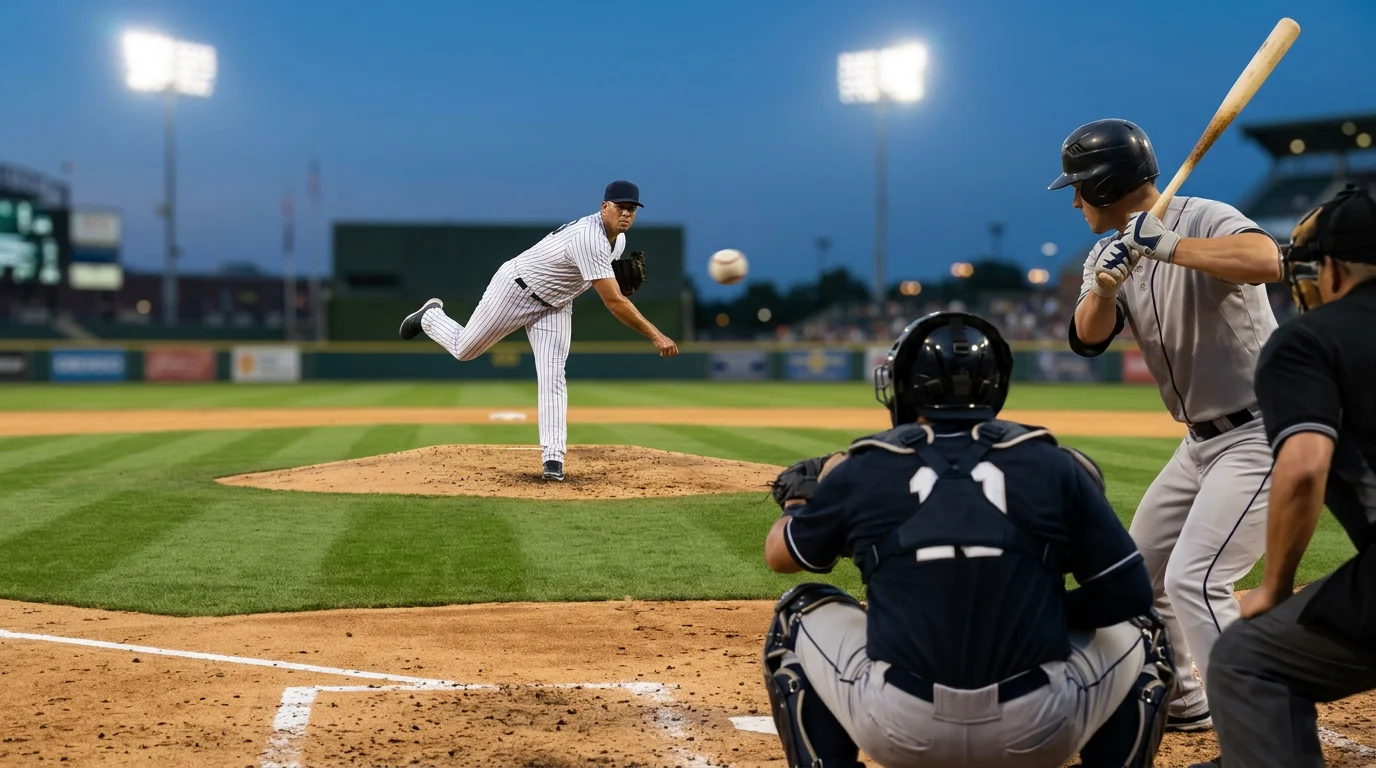
Batter Props
Batter prop — a wager on what an individual hitter will accumulate during a single game. Settled on the player's stat line for that match, regardless of the team result.
Home run props are the headline market — binary, will the named hitter clear the fence at least once. Even elite power hitters go deep in roughly a quarter of their games: Vladimir Guerrero Jr. homered in 42 of 161 games during his MVP-runner-up 2021 season, a 26% rate. That's why +300 to +360 (decimal 4.00 to 4.60) is the fair-value range for top bats; a 26% chance fairly priced sits at decimal 3.85.
Total bases props ask how many bases the hitter collects — single one, double two, triple three, home run four. The default line is "over 1.5", one of the most popular markets at UK books. Hits props (1+, 2+) and RBI props round out the batter category. Stolen base props have exploded since the 2023 rule changes that enlarged bases and limited pickoff attempts.
Pitcher Props
Strikeout props are the pitcher equivalent of HR props in volume. The line is a half-number (over 6.5, say) and you bet on how many opposing batters the named pitcher fans before he's pulled. The pieces nobody understands at first: how early modern starters get hooked — a complete game is now a once-a-month event leaguewide — and how heavily the opposing lineup's K-rate weighs on the line.
Outs recorded is a more granular cousin. Earned runs allowed asks how much damage the opposing lineup will do. Both have lower volume at UK books and both occasionally hide value for punters who do the research.
Game Props
NRFI ("no run first inning") and YRFI are the most popular game-level props at UK books. First-five-innings totals and moneylines are the next tier — you're betting only on action while the starting pitcher is still in. These markets sidestep the bullpen entirely, which removes a layer of variance.
| Category | Typical Markets | UK Availability | Where Edge Hides |
|---|---|---|---|
| Batter HR | To hit a home run, anytime | Wide | Park factors, wind, platoon |
| Batter Total Bases | Over/under 1.5, 2.5, 3.5 | Wide | Lineup spot, slugging splits |
| Batter Hits | 1+, 2+ hits | Wide | BABIP regression, contact rate |
| Batter RBI | To record an RBI, 2+ RBIs | Moderate | Lineup behind, RISP context |
| Batter Stolen Bases | To steal a base | Narrow | Sprint speed, catcher pop time |
| Pitcher Strikeouts | Over/under K total | Wide | Opposing K-rate, umpire |
| Pitcher Outs Recorded | Over/under outs | Moderate | Manager hook, bullpen state |
| Pitcher Earned Runs | Over/under ER | Moderate | Lineup quality, weather |
| Game Props | NRFI, F5 totals | Moderate | Starter caliber, top of order |
For the long-form breakdown by market — what each prop counts, how it settles, where the maths leads — I keep a full guide to MLB player prop types with category-by-category analysis.
BasePropPro tool · prop-sheet audit
The Loose Rung
A book posts six prices on the same batter for the same night. They are six views of one distribution, so they have to describe one man — and often they don't. This tool finds the rung of the ladder that disagrees with the other five. No player data required: the sheet is audited against itself.
Load a sheet
Slot and team total fix how many plate appearances he is likely to get — the one thing the price sheet cannot tell you and the lineup card can. Everything else is read out of the prices.
The sheet
Type the decimal prices your book is showing for one batter. Leave a box empty if the market isn't offered — four rungs is enough to run the audit.
The loose rung
—
The implied batter
The lineup-card swing
—
Where the sheet disagrees with itself
Each rung is measured against the price the other five imply for it. Anything inside the band is the same batter priced consistently. Anything outside it is a rung the book has priced on its own.
Three checks that need no model
These hold for every batter who has ever lived. A book that breaks one has broken it with arithmetic, not with an opinion.
His night, as the sheet describes it
Total bases the implied batter collects, and how the four thresholds cut it.
The same batter, moved around the order
Books post prop sheets before lineups are confirmed. These are fair prices — no margin in them — for the batter the sheet describes, at every slot, on the team total you set. Your row is highlighted.
| Slot | Plate app. | 1+ Hit | TB o1.5 | TB o3.5 | HR anytime |
|---|
Method, and what this tool cannot see
The model. One plate appearance is a draw over walk, out, single, double, triple and home run. Two free parameters move it: overall hit rate and the share of those hits that go for extra bases. Plate appearances are not fixed at four — the number is drawn from the team's total for the night and the batter's slot, which is why a leadoff man averages roughly 4.7 and a number nine roughly 3.9. Hits and total bases are then convolved exactly across the night, so all six markets come out of a single distribution rather than six separate assumptions.
The fit. The audit searches for the batter and the single percentage margin that best explain all the quoted prices at once, using an absolute-deviation fit so that one badly priced rung cannot drag the answer towards itself. What is left over — the deviation column — is each price measured against what the rest of the sheet implies for it.
What is robust and what is not. The margin figure depends on the model being right about the overall level, so read it as an estimate. The deviations depend only on the model being right about how the six markets relate to one another, which is a much weaker requirement — read those with more confidence. The audit assumes the book takes the same percentage cut on every rung; in practice books usually take more on longshots, so a discount showing on the longest price is weaker evidence than the same discount on a short one.
What it cannot see. This is relative value only. If the whole sheet is wrong about the player — wrong handedness matchup, wrong park, a bat that has cooled — every rung moves together and the audit sees nothing. It answers "which of these six is cheap", never "is this batter worth backing". The model also treats plate appearances as independent, ignores the pitcher change that arrives in the sixth, and does not know whether he is facing a left-hander. Fair prices carry no margin and are not available anywhere.
One free check the tool doesn't need. If your book lists Over 0.5 Total Bases as well as 1+ Hit, those two are the same event — a base can only come from a hit. Different prices on the same event is the cleanest thing you will ever find on a prop sheet. Take the longer one.
Editorial tool. Fair prices are model output, not offers, and carry no margin. Prices change; confirm everything with the operator before staking. 18+ · BeGambleAware
Reading MLB Prop Prices in Decimal and Fractional
The most expensive mistake new MLB punters make has nothing to do with picking the wrong player. It's mistranslating American odds into decimal in their head, settling on a price that "feels right", and not noticing they've shaved 8% off their own expected value before first pitch. American sites quote -110 or +280; UK books quote 1.91 or 3.80. Same prices, different uniforms.
Decimal is the cleaner format and the default at every UK book worth using. The decimal price is your total return per £1 staked, including stake. A price of 1.91 means a £10 winning bet returns £19.10 — your stake plus £9.10 profit. Multiply stake by decimal, that's your payout.
| Decimal | Fractional | American | £10 Stake Returns | Profit |
|---|---|---|---|---|
| 1.50 | 1/2 | -200 | £15.00 | £5.00 |
| 1.91 | 10/11 | -110 | £19.10 | £9.10 |
| 2.00 | 1/1 (evens) | +100 | £20.00 | £10.00 |
| 2.50 | 6/4 | +150 | £25.00 | £15.00 |
| 3.00 | 2/1 | +200 | £30.00 | £20.00 |
| 3.85 | 57/20 | +285 | £38.50 | £28.50 |
| 5.00 | 4/1 | +400 | £50.00 | £40.00 |
Implied probability is the next thing to internalise. Take 1 divided by the decimal odds and you have the price-implied chance of the bet landing. 1.91 implies 52.4%. 3.85 implies 26.0%. That's the book's view of probability with margin baked in — not the true probability, but the number you have to beat in your own head before placing the bet.
Calculating implied probability and expected value
Aaron Judge is priced at 3.85 to hit a home run tonight at Yankee Stadium against a left-handed starter.
Step 1: Implied probability: 1 ÷ 3.85 = 25.97%.
Step 2: My estimate of his true HR rate in this matchup: 28%.
Step 3: Expected value on £10: (0.28 × £28.50) − (0.72 × £10) = +£0.78.
Read: A small +EV bet (+7.8% per unit) — fine to play, not a hammer. Anything below +3% I leave for the books.
Fractional odds — 6/4, 9/4, 11/10 — are the older British format, still available as a toggle at most UK books. The numerator is profit per unit of stake. So 6/4 means £6 profit per £4 staked, or decimal 2.50. The conversion is fractional + 1 = decimal. I've never met a serious modern punter who keeps fractional as their default.
Overround is the bit American sites never explain. Add the implied probabilities of both sides of a two-way market. A typical UK MLB strikeout prop with both sides at 1.91 has implied probabilities summing to 104.7%. That 4.7% is the book's hold. On player props specifically, hold is consistently 8–15% rather than the 4–5% seen on moneylines. Knowing the hold tells you how much edge you need before a bet is profitable.
For the conversion mechanics with worked examples for every common American line and the maths of overround on multi-way prop markets, I built a decimal odds and fractional conversion manual for UK punters reading MLB lines.
The UK Bookmaker Landscape for MLB Markets
"Why don't you just use DraftKings?" An American friend asked me that on a call last summer. DraftKings and FanDuel won't accept a sterling deposit from a UK address — neither holds a UKGC remote licence. Every legal MLB prop placed by a British punter goes through a book licensed in Great Britain.
The structural difference matters. American operators run official league partnerships — MLB signed a multi-year authorised gaming operator deal with FanDuel in March 2023 — which gives them branded data feeds. UK books mostly run third-party feeds, which is why prop depth lags. The catch-up is happening, but you'll still find a US sportsbook listing 40 player markets per game where a UK book lists 12.
The four UK books with the deepest MLB prop coverage: Bet365, Sky Bet (owned by Flutter), William Hill (owned by 888 Holdings), and Paddy Power (also Flutter). All four hold full UKGC remote licences. Sky Bet and Paddy Power share corporate parentage, which explains why their MLB lines are often remarkably similar.
Flutter reported group revenue of $15.91 billion for the 2025 financial year, up 17% on 2024. Peter Jackson framed the growth as US-driven: "the scaling of our US business driving a step change in the earnings profile of the group." That US scale matters for UK punters indirectly — Flutter's American expertise feeds back into global MLB price-making. Online gambling in the UK generated £7.8 billion in GGY during 2024–25, a 13.1% rise.
What to Expect From UK Books on MLB
UK books vary in MLB depth, bet builder maturity, and request-a-bet availability. Larger operators carry more pitcher-specific props; smaller ones run narrower market lists. The structural feature to expect is the depth gap between US and UK sites — a 40-versus-12 markets-per-game spread is typical. Not a recommendation, just the texture you'll meet on a UK bet slip.
Settlement rules are where UK and US books diverge most. US sportsbooks routinely void player props on 90-minute rain delays or starter changes. UK books vary — some void on a starter not throwing a single pitch, others stand if at least one pitch is thrown. Always check the rules tab before staking on a starting pitcher market.
Cash-out on player props is patchy. Pre-game it's usually offered; in-play it disappears at most operators because trading risk is too high. Beyond the big four, smaller UK-licensed operators (Betfair, Coral, Ladbrokes, Unibet) carry MLB but with shallower depth. The Betfair Exchange is worth knowing as an alternative — peer-to-peer pricing where you can lay as well as back — but exchange volume on US sports props is thin.
For the side-by-side comparison of bet builder mechanics, settlement rules and depth across the major books, I keep a comparison of UK bookmakers for MLB props.
How Stadiums and Weather Reshape Prop Lines
I once watched a perfectly priced HR prop evaporate because of a 14 mph wind blowing in from right field at Wrigley. The pitcher was unremarkable, the matchup pure platoon advantage, the line generous. Three balls that would have cleared the wall on a still night died at the warning track. I'd checked the lineup, the pitcher, the splits — not the weather. I have ever since.
Park factors and weather are the difference between research that works and research that almost works. Every MLB stadium has a personality — dimensions, fence heights, altitude, prevailing wind — and bends prop lines in ways bookmakers don't always price aggressively. The line you see is a market average across stadiums; the truth is location-specific.

Park factor — a numerical index, usually around 100 representing league average, expressing how much a given stadium inflates or suppresses a particular outcome compared with the average MLB park. A HR park factor of 110 means homers happen 10% more often there than the league norm.
The classic hitter's parks are Coors Field (thin Denver air kills breaking pitches and lets fly balls travel), Cincinnati's Great American Ball Park, and Yankee Stadium with its 314-foot right-field line. Pitcher's parks: Oracle Park in San Francisco, Petco Park in San Diego, Detroit's Comerica. Wrigley Field ranks 28th of 30 for run-scoring with one of the deepest right-field portions in the league. T-Mobile Park in Seattle has the ninth-shortest fences in MLB and rates as the sixth-best park for left-handed home runs.
Wrigley Field
28th in MLB for run-scoring, deep right field, tall fences
T-Mobile Park
9th-shortest fences league-wide, 6th-best for LHB home runs
~30%
Share of MLB games decided by 1 run — affecting run-line and total props
2,430
Regular-season MLB games per year — a vast canvas of edge spots
Wind direction is the most underrated weather variable in MLB betting. A 10 mph wind blowing out at Wrigley adds roughly 5–6% to HR likelihood; a 10 mph wind blowing in subtracts about the same. Domed parks neutralise wind entirely — its own information. Temperature matters too — fly balls travel further in warm air — but the effect is gentler. Around 30% of MLB matches end with a one-run margin, with direct implications for run-line and total prop pricing.
The single best free habit for MLB prop research is checking wind direction at the stadium an hour before first pitch. Not the local forecast — the specific direction relative to the field's compass orientation. A 12 mph southerly at Yankee Stadium is wildly different from one at Oracle Park because the ballparks face opposite directions.
For the stadium-by-stadium breakdown — which parks favour right-handed power versus left, where altitude changes pitcher prop pricing, how crosswinds at marine ballparks affect total-base lines — see the deep dive on MLB park factors and weather.
The UKGC Reset of 2025 and What It Means for MLB Punters
I had a soft affordability check trigger in late March 2025, three weeks after the new £150 threshold came in. I'd deposited £160 across two days during opening week — unremarkable for me — and the operator's risk system flagged it. Two months of bank statements requested, uploaded, cleared in 36 hours. The new rules are real, and they affect how UK punters bet baseball.

The Gambling Commission supervises every legal online betting business in Great Britain. 2025 was the year a stack of consultations turned into actual rules — three of which directly change the texture of placing MLB props from a UK address.
The Statutory Levy: April 2025
From 6 April 2025, the UK replaced its voluntary research-education-treatment funding model with a statutory gambling levy that operators must pay. Funds flow into addiction research, public health interventions, and treatment services. The levy is a real cost on operators' P&L, which gives trading desks one more reason to widen margins on lower-volume markets — and MLB props sit firmly in lower-volume territory at most UK books.
The £150 Vulnerability Threshold
The bigger operational change for individual MLB bettors arrived on 28 February 2025: financial vulnerability thresholds dropped to £150 in net deposit losses across a rolling 30-day period. Hit £150 in net losses and the operator runs a light-touch check — usually a passive look at credit-bureau data, sometimes a soft request for bank statements.
What £150 actually means: the threshold is on net deposit losses, not stake volume. Deposit £200 and withdraw £100, that's £100 in net losses — under the threshold. Deposit £160 with no withdrawal and you hit it. Checks aren't triggered by how much you bet, they're triggered by what you've lost.
If the check escalates, documents are next. Andrew Rhodes at IAGR 2025: "4.31 per cent of accounts are being restricted... probably talking at something like 1-2 per cent of people who are gambling had their account restricted." Small in absolute terms — but if you're in it, you're in it.
The Compliance Backdrop
The regulator has teeth. If the Commission revokes a licence, supply stops immediately — translation: betting with a UK-licensed book is genuinely safer than at any prior point. Crypto regulation is the next wave Rhodes flagged: "What I thought was a five-year-away problem... I think is now an 18-months-to-two-years challenge." UK punters can't legally bet MLB through a crypto-only operator, and that gap is narrowing.
✓ Do
- Track net deposit losses across the 30-day window so the £150 threshold doesn't surprise you
- Keep recent bank statements handy in case an enhanced check escalates
- Use only UKGC-licensed operators for MLB props
- Set deposit limits in your account before the season starts
✗ Don't
- Open multiple accounts to dodge affordability checks — operator data-sharing flags this
- Ignore a soft check email assuming it'll go away — your account will go restricted
- Take an offshore site's "fast withdrawal" promise at face value — no UK consumer recourse
- Treat affordability documentation as adversarial — prompt uploads clear checks fastest
For the granular regulatory detail, I keep a UKGC rules guide for MLB bettors with the affordability journey laid out step by step.
The UK Time-Zone Problem and How to Live With It
My most reliable MLB-watching habit is a slow-cooked stew on a Saturday evening, a New York start at 19:05 ET hitting my London kitchen at midnight, and a deliberate refusal to follow West Coast 22:00 ET games — 03:00 UK time, and I have a teenager, a job, and self-respect. The time-zone gap is the single most underrated practical issue for UK MLB punters.
The 2026 season opened on 25 March, the earliest in league history. From late March onwards, with both countries on summer time, a 19:05 ET East Coast start lands at 00:05 BST. West Coast 19:05 PT becomes 03:05 BST. Day games at 13:05 ET hit 18:05 BST — the easiest UK windows.
East Coast 19:05 ET
00:05 BST — workable late-night for UK
Central 19:05 CT
01:05 BST — tough but doable
Mountain 19:05 MT
02:05 BST — for committed punters
West Coast 19:05 PT
03:05 BST — pre-game only
Day game 13:05 ET
18:05 BST — the easiest UK slot
Getaway day 12:35 ET
17:35 BST — afternoon prop window
How the Schedule Shapes Your Betting
UK punters who try to live-bet West Coast games end up making sleep-deprived decisions on prop markets — a recipe for staking emotionally rather than analytically. Pre-game props on West Coast contests are fine; in-play on those games is where bad bets multiply. East Coast night games and weekend day games are the genuine UK live-betting windows.
UK time-zone betting checklist
- Confirm first-pitch time in BST or GMT before staking — not in ET
- If first pitch is past 02:00 local, pre-stake or skip
- Check for doubleheaders — twin-bills change starter availability and prop pricing
- Mind the daylight-saving misalignment: UK and US shift on different weekends
- Plan in-play windows around East Coast night and weekend day games
Daylight saving creates a fortnight of confusion every spring and autumn. The UK shifts to BST on the last Sunday of March; the US shifts on the second Sunday. For the intervening fortnight the gap is four hours rather than five. I've stake-misjudged at least one game by an hour during that window.
Doubleheaders fundamentally change prop availability: the second-game starter often isn't named until after the first ends, so UK punters pre-betting that game are betting blind on pitcher props. The 2023 pitch clock has shaved roughly 25 minutes off average game time — an East Coast 19:05 first pitch now reliably wraps before 03:00 BST. UK live betting is marginally more viable than it was, but the West Coast problem isn't going anywhere.
Surviving 162 Games Without Wrecking Your Bankroll
My first serious MLB season, I was up £400 in May and broke by July 4th. The picks weren't terrible — ROI on individual bets was positive — but I'd been staking like a Premier League punter on a sport that runs every night. Six props a night, sometimes ten. Four months of that compounds into a hole regardless of edge. Bring football staking discipline to a 162-game season and the maths catches up faster than you'd believe.
The 2,430-game regular season is what makes MLB unique among legal UK betting sports. A game every night, several on most nights, six full slates a week from late March through September. The cadence is intoxicating — and over-betting is the single biggest enemy of long-term UK punters in this market.

Unit Sizing for the Long Haul
Standard discipline says one unit equals 1% of your bankroll. For an MLB season I push that lower — 0.5% per prop — because temptation volume dwarfs any other sport. £1,000 bankroll, a unit is £5. A serious-feeling bet is two units, maximum bet three units. More than that is, by definition, an emotional decision rather than an analytical one.
The 162-game staking maths
Bankroll: £1,000. Unit size at 0.5%: £5.
Scenario A: Four props a night at one unit each. 4 × £5 × 162 nights = roughly £3,240 in stake volume.
Scenario B: Two props a night, only on identified-edge games. 2 × £5 × 100 nights = £1,000 stake.
Read: Scenario A's variance can wipe a 3% ROI edge. Scenario B preserves edge because volume is matched to confidence.
Flat staking — same unit on every bet regardless of perceived edge — is probably the best system for casual MLB punters. It removes cognitive load and protects you from your own overconfidence. The Kelly criterion is mathematically optimal but demands you know your edge with precision. You don't. Nobody does.
Tracking Without Becoming Obsessed
Track which prop categories you actually have edge on. After a full season I usually find I'm a positive-ROI HR-prop bettor, slightly negative on strikeout overs, break-even on total bases. That's information I can act on next year. Without tracking, you blur the categories together and assume your overall result reflects your overall skill — when in fact a strong sub-skill might be dragged down by weak ones.
The £150 net-loss threshold dovetails with bankroll discipline. If your monthly stake volume is calibrated so you're not consistently hitting £150 in losses across any 30-day window, affordability checks won't trigger and your bankroll plan is clearly within sustainable territory.
Drawdown management is the third leg. Even good prop bettors lose ten or fifteen in a row — small samples mean nothing. Don't increase stake size during the drawdown; the urge is overwhelming, the maths says no. With roughly 30% of MLB games decided by a single run, variance on game-result-adjacent props is genuinely high. Treat the season like a marathon and you'll finish standing. Treat it like a sprint and you're out by the All-Star break.
Where Edge Actually Hides in Prop Research
A young punter messaged me last March asking what tools I subscribe to. I sent him a screenshot of my bookmark bar — Baseball Savant, FanGraphs, a weather site, the MLB.com lineup tracker — and he replied "no, I mean the paid stuff, where's your edge from". Honest answer: paid tools help, but the edge isn't there. The edge is fifteen extra minutes per game cross-referencing what's free, while everyone else flicks through Twitter for picks.
The Dimers projection model runs 10,000 simulations per game and updates for news, injuries and weather. Its historical "outs recorded" identification has returned 9.6% profit across 108 similar wagers — a published backtest. Tools like that exist. But the edges they find can also be found by a human with discipline doing the same work manually — the variables are public.
The Free-Tools Stack That Beats Most Subscriptions
Pre-bet research checklist for any MLB prop
- Confirm the starter is actually starting — late scratches happen and shift props
- Check the opposing lineup card — depleted lineups change pitcher prop maths
- Read wind direction at the stadium an hour before first pitch
- Check the umpire on strikeout props — strike-zone size varies by ump
- Cross-reference the line against at least two UK books — line shopping is the cheapest edge
- Verify settlement rules if there's any chance of a rain delay
Baseball Savant is the public arm of MLB's Statcast — exit velocity, launch angle, every batted ball. Free. FanGraphs publishes FIP, xFIP, SIERA, wOBA, xwOBA — metrics that genuinely move prop lines. Free. The MLB.com lineup tracker shows who's playing and where in the order. Free. Paid tools add convenience and save time. They don't add edge that isn't already accessible.
What Edge Actually Looks Like
Edges that survive in modern markets are small. A 3–5% positive expected value on a single bet is genuinely good. A 9.6% historical edge on a specific prop spot is exceptional and unstable. Anyone claiming a 15% ROI system is either lying, has tiny sample size, or both. Real edge lives in park-and-weather mismatches the market hasn't priced, late lineup-card changes, and platoon splits the line ignores.
Closing-line value — the price you got versus the price the market settled at minutes before first pitch — is the single best long-term diagnostic. If your bets consistently move toward your side after you've placed them, you're reading the market correctly.
CLV as the truth-teller: backed a strikeout over at 1.95 three hours before first pitch, line settled at 1.85? Positive CLV. Drifted to 2.05? Negative. CLV across hundreds of bets is the cleanest signal of edge — much cleaner than win-loss record, which is dominated by variance over short timescales.
The two MLB pitchers charged in a 2025 match-fixing case are a reminder that prop markets attract integrity risk specifically because they're micro-events a single person can manipulate. UK books have tightened on micro-prop liability since. The practical effect is mostly invisible — but if you ever see a strikeout prop go from 1.85 to 2.40 with no obvious news cause, that's the integrity team flagging something. Walk away.
Keeping the Hobby a Hobby Under Modern UK Rules
I've watched two friends spiral on baseball betting because the cadence of the sport — every night, multiple games, dozens of markets — turned out to be a perfect environment for compulsive patterns to take root. Both are fine now. One self-excluded for six months and came back a once-a-week recreational bettor. The other moved to fantasy baseball without money. Neither is a cautionary cliché — just stories of how easily MLB's volume can change your relationship with the sport.
The UKGC's framework around responsible gambling is genuinely useful, not compliance theatre. Every UK-licensed book offers self-imposed deposit limits, time limits, reality checks, and self-exclusion through GAMSTOP. None has downside for a healthy recreational punter — protective rails you barely notice if you don't approach them, life-savers if you start to.
The cadence of MLB — a game every night, 162 nights a year — makes self-imposed limits more important here than in any other UK betting market. Set deposit and time limits at the start of the season, not when you notice trouble.
The 4.31% account-restriction figure is the share of active accounts that triggered some form of operator-imposed restriction in a 12-month window. If you're in that group, it's not a punishment — it's a flag that your betting pattern looked unusual relative to your established history. Operators are now required to act on those flags in ways they weren't a few years ago.
The 2025 match-fixing charges sit alongside the regulator's broader 300% year-on-year rise in criminal cases. Andrew Rhodes was unflinching at IAGR 2025: "Year on year we saw a 300 per cent increase in the number of criminal cases we were taking as a regulator." None of this should scare a recreational punter — the legal UK MLB market is safer than it's ever been — but it's the environment your bets sit inside.
If anything in this guide is starting to feel like it's describing your own habits a little too closely — chasing losses, betting more than planned, hiding the activity from people you live with — UK-based help is available immediately and confidentially. GamCare runs the National Gambling Helpline. Talking to someone is the only thing that actually moves the needle.
The healthy frame for MLB betting from the UK is hobby cost, not income strategy. Most of us are paying for entertainment plus the occasional dopamine hit when a Judge HR prop lands. Think of the season's expected betting cost the way you'd think of a season ticket — a known number, budgeted in advance, not exceeded. The 162-game season that creates so much edge opportunity also creates the volume to overshoot. Discipline isn't optional — it's the precondition for any analytical work to mean anything at all.
Frequently Asked Questions From UK MLB Punters
What are MLB prop bets and how do they differ from regular baseball wagers?
An MLB prop bet — short for proposition — is a wager on a discrete in-game event rather than the match result. Standard wagers are the moneyline, the run line (a 1.5-run handicap), and the total. Props ask narrower questions: will Aaron Judge hit a home run, will the starting pitcher record over 6.5 strikeouts, will the first inning be scoreless. Settlement turns on the player or sub-game outcome regardless of who wins.
Which UK bookmakers offer player props on MLB?
Four UK-licensed operators carry the deepest MLB prop coverage: Bet365, Sky Bet, William Hill and Paddy Power, all holding full UKGC remote licences. Smaller licensed books — Betfair, Coral, Ladbrokes, Unibet — also offer MLB but with shallower depth. US operators like DraftKings and FanDuel are not legally available to UK addresses, lacking UKGC licences.
How do you read MLB odds in decimal format on UK sites?
Decimal odds tell you total return per £1 staked, including stake. A price of 1.91 means a £10 bet returns £19.10 if it wins. Implied probability is 1 divided by the decimal price — 1.91 implies 52.4%, 3.00 implies 33.3%. Most UK books default to decimal but offer fractional or American toggles. Decimal is cleanest for prop research because EV, overround and CLV all run on decimal numbers.
What are the most popular MLB prop markets for British punters?
Home run props lead by volume — long-odds payout, binary outcome. Strikeout props on starting pitchers come second. Total bases over 1.5 is the next big batter market because it's slightly more forgiving than a pure hit prop. NRFI is the most popular game prop. RBI and stolen base props have grown since the 2023 rule changes around bigger bases and pickoff limits.
How do new UKGC rules in 2025 affect MLB betting?
Two changes matter directly. From 28 February 2025 the financial vulnerability threshold dropped to £150 in net deposit losses across a rolling 30-day window. From 6 April 2025 a statutory levy on operators replaced the voluntary RET model. Account restrictions affected 4.31% of active accounts in a 12-month window. None of this changes whether UK punters can bet on baseball.
What time do MLB games start in the UK and how does that affect live betting?
East Coast night games (19:05 ET) start at 00:05 BST in summer. Central games hit at 01:05 BST, Mountain at 02:05, West Coast at 03:05. Weekend day games at 13:05 ET are the easiest UK slot — 18:05 BST. Most disciplined UK punters pre-stake West Coast props and reserve in-play for East Coast night and weekend day games. The 2023 pitch-clock rule trimmed about 25 minutes off average game time.
Which strategies actually work across MLB's 162-game season?
Three survive long-term: line shopping across UK books, park-and-weather research feeding into HR-prop and total-bases bets, and ruthless bankroll discipline — flat-staking at 0.5% per prop, tracking ROI by category, refusing to chase drawdowns. Strategies that don't survive: hot-streak chasing, parlay-heavy approaches, betting every night because the schedule offers it, trusting any tipster claiming sustained 15%+ ROI.
The Long View: Treat MLB Like a Marathon, Bet Like a Pro
The frame to leave with isn't tactical — it's temporal. Football and racing are episodic: a weekend, a meeting, a finite event you bet against and then put away. MLB is continuous. The season starts in late March and runs to October, and within that span there's a game tonight, tomorrow, every hour of every day for half the year. Discipline is the act of treating that continuity as a feature rather than a temptation.
The British market for baseball is real now — 5.9% of UK sports fans interested, 452,000 followers across MLB Europe, 15 games a year on TNT Sports, growing UKGC-licensed bookmaker depth. The infrastructure is here. What's been missing is the literature for British punters who want to bet baseball with the same fluency they bring to football, and the slow translation work — decimal pricing, park factors, time-zone planning, regulatory awareness — closes that gap.
Chris Marinak put MLB's view of Britain plainly: the U.K. is a "priority market" for international growth. The flip side is the betting opportunity. UK books are improving their MLB depth specifically because demand is climbing. Punters reading early on a growing market have a window of relative inefficiency before the lines tighten further.
None of the analytical work in this guide matters without the discipline behind it. Park factors don't pay if you've blown the bankroll on parlays. Decimal-odds fluency doesn't help if you're betting West Coast props at three in the morning. The 162-game season is the longest sustained legal betting opportunity available to UK punters, and the one that punishes indiscipline most reliably. Approach it as the marathon it is, build the daily habits that survive a six-month grind, and the edges covered here will compound rather than evaporate.
BasePropPro Articles: MLB Prop Bets Strategies
MLB Run Line vs Handicap: Pricing Alternate Betting Lines
Evaluating the 1.5-Run Default in Handicap Betting I have lost more tickets to a 1-run margin than to any other type of MLB result. The match goes my way, the…
Line Shopping MLB Props in the UK: Aggregators and CLV Tracking
Implementing Manual and Aggregator Line Shopping Workflows I once spent an entire…
UK Statutory Levy: Mechanics and MLB Prop Price Implications
Statutory Levy Effects on UK MLB Betting Bankrolls The biggest single regulatory…
Betting the London Series: UK Stadium Dimensions and Punter Angles
Analyzing London Stadium Dimensions for Prop Bets The first London Series in…
Created by the "BasePropPro" editorial team.
