
Betting the London Series: UK Stadium Dimensions and Punter Angles
 Available in US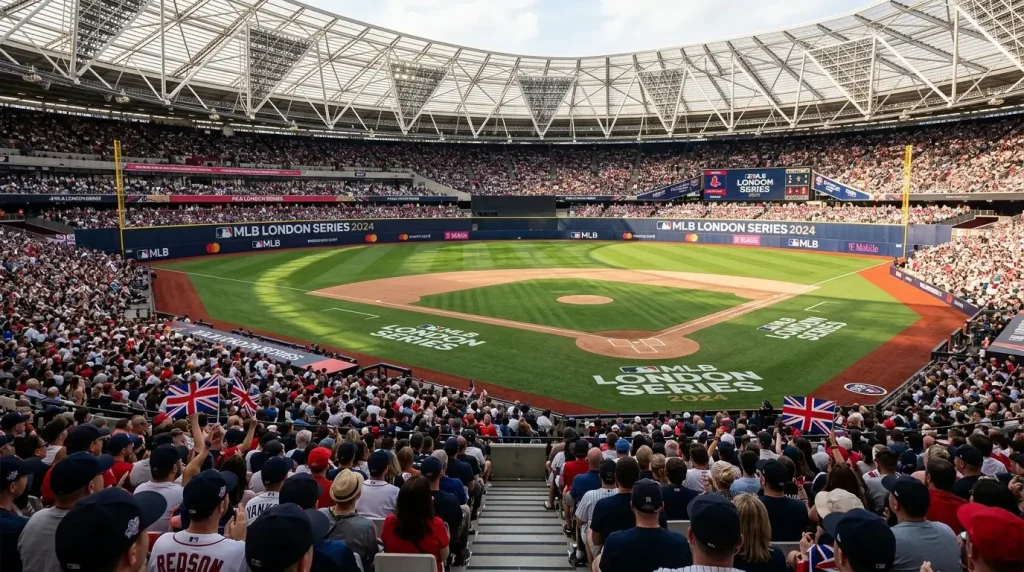
Analyzing London Stadium Dimensions for Prop Bets
The first London Series in 2019 was a strange and wonderful event. Yankees against Red Sox at the London Stadium, a venue built for athletics and West Ham, dropped almost 119,000 fans across two games, and produced two of the highest-scoring contests in MLB postseason or regular-season Yankees-Red Sox history. Watching the punter behaviour in the days leading up to those games taught me that the London Series is its own micro-market, and that pricing the props for it requires a different mental model than a regular-season East Coast game.
UK punters bring different priors to London Series games than American punters do. We see the broadcasts of regular-season games largely as scheduled events for late-night viewing – interesting but distant. The London Series, by contrast, sits in our actual UK afternoon, with stands full of British fans, and that proximity produces betting behaviour that is sometimes irrational and often exploitable. Across the recent series, the structural data has been clear: scoring lifts dramatically at the London Stadium configuration, and the lines do not always adjust by enough.
London Series History and What the Numbers Tell Us
The 2019 inaugural series – Yankees vs Red Sox – drew nearly 119,000 fans across two games. The 2023 instalment, with the Cubs facing the Cardinals, generated an estimated $67 million economic impact for London, with an average attendance of 55,000 per game and 71 per cent of fans confirmed as UK residents. That last figure is the one that matters most to me as a punter – it tells you the London Series is not a road show for visiting Americans, it is a genuine British sporting event with a domestic-heavy crowd, and the pricing mistakes made by the wider market reflect that growing UK demand without fully understanding it.
The Greater London Authority granted £300,000 in 2017 to help attract MLB to the city, and the investment has paid back many times over in tourism receipts and event spend. MLB’s social channels in the UK grew by 133 per cent in the year leading up to the 2024 series, and merchandise sales in Britain rose 43 per cent over the same period. The growth pattern is unambiguous: the London Series has been the single most effective vehicle for MLB to embed itself in the UK sporting calendar.
For prop punters, the implication is that the volume of UK money flowing into London Series markets is large and growing – and that money is, on average, less expert than the money flowing into a Tuesday-night Yankees-Orioles game in May. Where the money is less expert, the lines move on noise rather than signal, and the structural mispricing opens up. Chris Marinak, MLB’s Chief Operations and Strategy Officer, said in a 2023 interview that the U.K. has really been identified for us, London in particular, as the jumping off point for us to get into Europe. We feel like we proved that out in 2019.
That executive priority translates directly into the league pushing more product into the UK, which translates into more UK casual money in the betting markets, which translates into more mispricing for disciplined punters.
London Stadium Dimensions and the Scoring Lift
The London Stadium configuration for MLB is not a regulation ballpark. The diamond is dropped onto a converted athletics venue, which means the foul territory is unusual, the outfield dimensions are pulled in compared to most American parks, and the wind patterns inside the stadium bowl are unique to the venue. The 2019 series produced 50 runs across two games – astronomical scoring even by hitter-friendly American standards. The 2023 series saw similar elevation, with scoring well above the season averages for both participating teams.
The drivers are clear. Outfield dimensions at London Stadium pull in significantly compared to typical MLB parks. The right and left field walls are closer than at most regulation venues, which inflates home-run rates substantially. The wind, sheltered by the stadium structure, behaves differently from open-air ballparks but still tends to favour hitters more than pitchers across the configurations used. The pitching mounds are temporary structures; not the same as the season-conditioned mounds the pitchers train on. Add jet lag for the visiting team and accumulated travel fatigue, and the structural setup tilts heavily toward offence.
What this means for prop pricing: home-run props are systematically too short for power hitters in the London Series, and pitcher strikeout props are systematically too long. Books adjust the lines, but rarely by enough to capture the full magnitude of the venue effect. UK punters who have watched the games in person, or who have done the basic park-factor work, have a clear edge over the casual American money flowing in around the headlines. For more on the underlying park-factor framework, the park factors guide goes into far greater detail on how dimensions and wind translate into prop expectations.
The 2026 Cancellation and What It Tells Us
The 2026 London Series – Yankees vs Blue Jays – was scheduled for 13 to 14 June and then cancelled. The reason was scheduling conflicts with West Ham’s stadium needs and Fox’s broadcast commitments around the FIFA World Cup, which Fox had won the rights to that summer. The cancellation was disappointing for UK fans but instructive for prop punters.
What the cancellation tells us is that the London Series remains a privileged event in the MLB calendar but a logistically fragile one. Its dependence on a single convertible venue, on broadcast clearance windows, and on visiting-team scheduling cooperation makes the series less reliable as a fixture than the casual UK punter might assume. Future iterations are expected to return – MLB has signalled clear ongoing commitment to the UK market – but the punter should not be committing serious bankroll to London Series futures or futures-adjacent markets ahead of confirmed scheduling. The cancellation also serves as a reminder that any future-bound market on a yet-to-be-confirmed series carries scheduling risk that books may or may not price into their voiding rules.
Prop Angles for Future London Trips
When the series returns, the angles are likely to remain consistent with the pattern established across 2019, 2023, and 2024. The cleanest setup for over bets is on home-run props for top power hitters with platoon-favourable matchups against the announced starting pitchers. The structural lift from the venue, combined with the visiting-team fatigue, compounds in favour of offence-side prop overs.
The pitcher side is harder. Pitcher prop unders look attractive on the surface – fewer expected innings due to a less-rested setup, lower expected strikeouts due to a contact-friendly venue – but books price these aggressively because they know the obvious narrative. The opposite trade is sometimes more profitable: pitcher prop overs on starters who carry deception-based stuff that does not depend on velocity or whip-back deep pitches. Sliders and changeups often hold up better in unusual venues than power fastballs, and pitchers with that profile can outperform the discounted line. This is exactly the kind of angle the casual punter never gets near.
The other angle is team total overs. Both teams typically clear their season averages for runs scored in London Series games, often by 2 to 4 runs combined. The total line moves up to compensate, but the move is rarely enough to fully price in the venue lift. Backing the over on team totals is often more profitable than backing individual home-run props, because the variance is lower and the structural lift applies regardless of which individual hitters do the damage.
What I Would Tell a UK Punter Heading to London
If you have tickets and you want to combine the experience with informed staking, the homework starts with the announced starting pitchers as soon as they are released. Look at their splits in unusual venues – international tours, neutral-site games, alternative ballpark configurations. Some pitchers travel well, and some do not. The ones who do not are the soft pitcher-prop unders, but only at the right price. For position players, focus on the platoon advantage and on power profile in the lineup. The London Stadium configuration rewards left-handed pull power and right-handed gap power; backing those profiles for total bases or home-run props is where the structural edge sits.
The London Series is a different bet from any regular-season MLB game. Treat it as such, do the venue-specific homework, and respect the fact that the casual UK money in the market is large enough to push lines in directions that disciplined punters can exploit. When the series returns to the calendar, it is one of the highest-edge weekends of the year for UK MLB punters who have done the work.
BasePropPro Articles: MLB Prop Bets Strategies
+EV MLB Props: Devigging Prices and Calculating Expected Value
Calculating Realistic Edge Thresholds for MLB Props I spent two years thinking +EV was a marketing word the analytics community used to make their picks sound smarter than mine. Then…
MLB Lineup Card Props: Late Scratches and DH Rotations
Adjusting Props Based on Late Lineup Card Scratches I had a prop…
MLB Earned Runs Allowed Props: FIP Baselines and Pitcher Damage
Utilizing FIP Over ERA for Earned Run Props If you want a…
MLB Stolen Base Props: Sprint Speed and Market Adjustments
Exploiting New MLB Rules for Stolen Base Props Until 2023 I rarely…
Published by the BasePropPro team.
